
Latest News
- Home
- Latest News
- Collated Screws vs. Self-drilling Screws: Which Is Faster?
2026.04.10
Latest News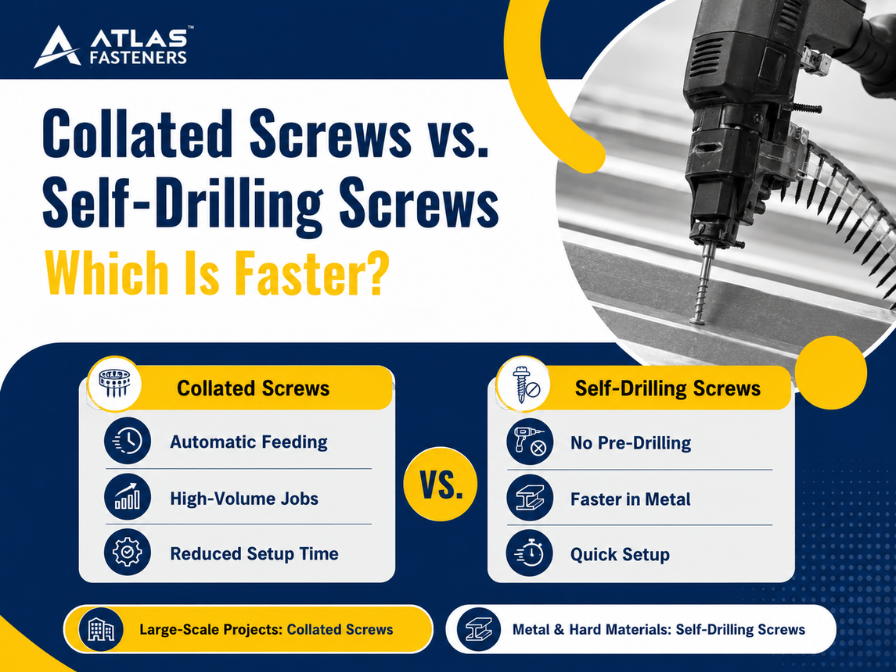
When comparing collated screws and self-drilling screws, speed is one of the key factors to consider. Both types of screws have their advantages, but they differ in installation speed, efficiency, and application suitability. Let's break down how these two types of screws stack up against each other in terms of speed:
Collated Screws: Speed Advantages
- Automatic Feeding: Collated screws are pre-loaded into a strip, allowing them to be fed automatically into a screw gun or driver. This automatic process eliminates the need for manual loading, saving time during installation.
- Consistent Delivery: Since collated screws are loaded in a continuous line, they provide a consistent and quick delivery, which is particularly beneficial for larger projects that require high-volume screw installation (e.g., decking, drywall, or large-scale woodwork).
- Reduced Setup Time: Once the tool is loaded, the process is faster compared to manually loading screws one by one, and there’s no need to pause for every screw insertion.
- Speed Benefit: Collated screws offer a significant speed advantage for high-volume applications due to their continuous feed and automatic loading.
Self-Drilling Screws: Speed Advantages
- No Pre-Drilling: Self-drilling screws come with a built-in drill bit at the tip, which means they don't require a pilot hole before installation. This is particularly useful for metal or harder materials, as it eliminates the need to switch between tools or pre-drill holes, which can slow down the process.
- Quick Setup: Self-drilling screws can be directly inserted into the material with a power drill, making the installation process quicker than using traditional screws that require a pilot hole.
- Ideal for Metal: If you are working with metal or other hard materials, self-drilling screws can save significant time compared to using standard screws that would require pre-drilling.
- Speed Benefit: Self-drilling screws provide faster installation when working with metal or materials that do not require pre-drilling, as the built-in drill bit simplifies the process.
Which Is Faster?
- For Large-Scale Projects: Collated screws generally offer faster installation speeds due to their automatic feeding mechanism. For large projects, such as framing or roofing, where a high volume of screws is required, collated screws will save time over self-drilling screws because they can be automatically loaded into the tool.
- For Precision in Metalworking: Self-drilling screws may be faster for smaller, more focused tasks where you need to drill directly into metal or harder materials without the hassle of pre-drilling. They are efficient when only a few screws are needed, or the material doesn't require multiple steps.
Frequently Asked Questions (FAQ)
Q:What are collated screws? +
Collated screws are screws that are pre-loaded into a tool in a continuous strip or clip, allowing for automatic feeding during installation, making the process more efficient.
Q:What is the difference between collated screws and self-drilling screws? +
Collated screws require a specific tool for automatic loading, while self-drilling screws have a built-in drill bit that allows them to penetrate materials without the need for a pilot hole.
Q:What are the common uses for collated screws? +
Collated screws are typically used for large-scale installation projects such as decking, siding, wood structures, or drywall installations, especially in situations where high installation efficiency is required.
Q:What materials can self-drilling screws be used with? +
Self-drilling screws are suitable for use with metals, steel, and other harder materials, as their built-in drill bit allows them to penetrate these materials without pre-drilling.
Q:Which is faster, collated screws or self-drilling screws? +
For large-scale projects, collated screws tend to be faster due to their automatic feeding design. However, self-drilling screws can also be fast when working with metals or other hard materials, as they eliminate the need for pre-drilling.
Q:What tools are needed to use collated screws? +
Collated screws require specific tools, such as a screw gun or electric screwdriver, that can automatically load and quickly install the screws.
Q:Do self-drilling screws require special tools? +
No, self-drilling screws can be installed using a standard electric drill or screwdriver.
Q:Which type of screw is better for handling high-strength metal materials? +
Self-drilling screws are better suited for use with metals and steel, as their drill bit design allows them to easily penetrate these harder materials.